
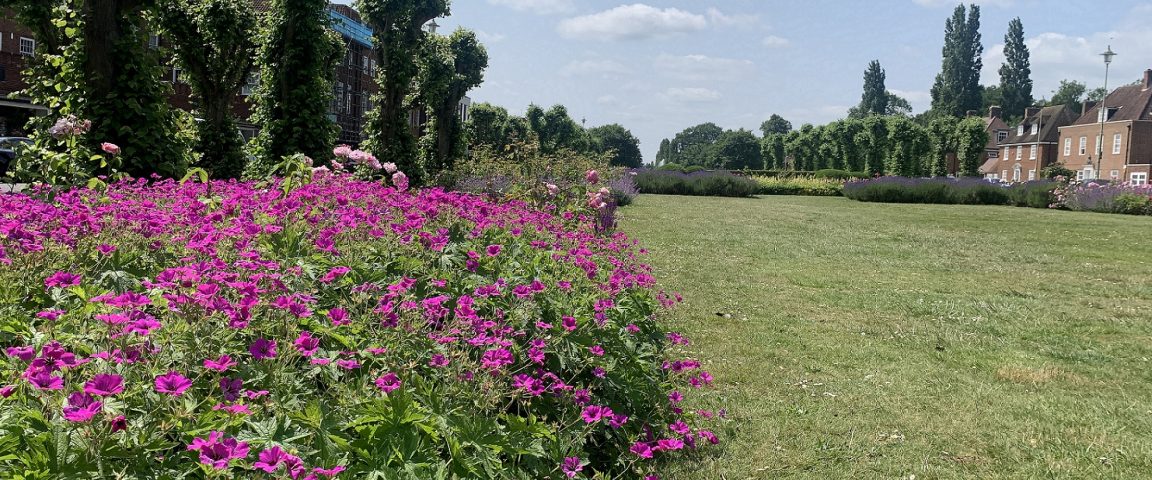
Welwyn Garden City Centre Gardens
Open all year
Welwyn Garden City town centre is a busy shopping and entertainment district, but it also features many gardens which people can freely visit.
75th Anniversary Arch
Artwork
It is a wrought iron pergola, with three legs raising to a canopy dome of branches and leaves leading to a gold coronet of flowers.
Buried underneath is a time capsule to be open in 2095, which includes a photo of 75 people from the ages of 1 to 75.
Ad Astra
Artwork
‘Ad astra’ is a Latin phrase meaning “to the stars”. The bronze, nude man is stretching to see the sky above, taught on his toes, slightly inclined with hands behind his head to assist his view.
This stature was sculpted by Kathleen Scott (later Lady Kennet of the Dene). Kathleen Scott was a very sought after artist for public sculptures in the 1940’s and 1950’s.
Anniversary Gardens
Plant Bed
It features ornamental grasses and prairie-style plants such as Achillea and Rudbeckia, which provide long-lasting summer and autumn colour while supporting pollinators. This style of planting is sustainable and will develop as the garden matures over time. During the winter, plants such as snowberry will provide winter interest.
The garden is very accessible with surfaced paths and features many benches to rest. Information boards provide additional details.
Centenary Woodland Garden
Plant Bed
This garden is at its most spectacular between January and late April. Established with plants which occur naturally in woodland dells and glades, the scheme provides a rich feast for the senses.
The garden is accessible with grass paths and features many benches to rest. Information boards provide additional details.
Common ash
Feature Tree
Native
Currently a commonly found tree as it is a prolific self-seeder. Ash has useful wood which can be utilised to make many products from ornamental bowls to cartwheel rims!
Identifying features are large, black buds on thick twigs. Bunches of winged seeds are retained through winter, for spring dispersal. Leaves are made up on numerous, paired leaflets on a long stalk, known as a midrib.
Common beech
Feature Tree
Native
Beech are mystical species which were once venerated for their medicinal properties and the potential to learn the unknown using their twigs as diving rods.
The seeds of the beech are tiny angular nuts housed in a small spiny cases, about the size of a large grape. This is called beech mast and often collects around the base of the tree through autumn and winter. The bark of the stem is a solid, smooth grey. The leaves are very simple in shape, an oval, but the crowns of the trees are very dense, casting a deep shade.
Crab apple
Feature Tree
Non-native garden origin – a hybrid species
Crab apples are great garden trees, providing forage for insects in spring and little apples for birds, small mammals and insects in the autumn or winter.
This crab apple is named ‘Director Moerland’ after a former head of the School of Horticulture in Boskoop. An internationally important centre of plant development.
Crab apples tend to be robust little trees. In autumn they have pretty coloured apples, in a range of sizes, and shapes! In spring they look very similar to cherry trees.
Dawn redwood
Feature Tree
Non-native originating from China
This tree was planted by the Welwyn Hatfield Tree Wardens to commemorate Queen Elizabeth II Diamond Jubilee in 2012.
Dawn redwoods were formally identified in China in 1941 but previously had only been known to western science through fossils. The common name for the tree in China is ‘water fir’.
An unusual conifer tree as it is deciduous. The feathery foliage turns a wonderful copper colour in autumn.
Dick and Celia Reiss Memorial Garden
Plant Bed
In 1919 Dick Reiss surveyed the farmland which was up for auction and would later be developed into Welwyn Garden City. At the time he was working with Ebenezer Howard and the Garden City Company creating Letchworth Garden City and promoting the values of the New Towns Movement.
The Reiss’s then moved to one of the first houses built in Welwyn Garden City in 1922.
As a couple, they continued to promote New Towns and the Garden City Movement. Over the years they also founded the Health Association (establishing child welfare and district nursing services in the town pre NHS), set up Peartree Boys’ Club and a cricket club, built a nursery school, sat on the board of the Educational Association, and helped refugees fleeing Europe in the late 1930s.
This small garden includes seating and mown grass paths.
Ebenezer Howard Statue
Artwork
Ebenezer was an urban designer and entrepreneur who thought people would benefit from living more harmoniously with nature as part of their everyday lives. He found the farmland to develop and the funding to build WGC and oversaw the design to ensure it lived up to his dream of providing people better lives.
This commemorative stature was erected to celebrate 100 years of WGC in 2020. It was sculpted by Ben Twiston-Davies, with lettering by Simon Langsdale.
English oak
Feature Tree
Native
There are a number of oak tress planted in recent years to commemorate events. You can find a tree to celebrate 100 years of Welwyn Garden City, planted in 2020 and one to celebrate the United Nations.
Most easily identified when there are acorns in their little cups growing or falling from the tree, the oak is a frequently found tree in Hertfordshire. During winter, the bare twigs can be identified through the distinctive buds at the very end of the twig. There will be one large central one, the king bud, with smaller buds clustering around it.
Field maple
Feature Tree
Native
Field maple is an unsung hero of the British landscape. A bountiful tree for foraging insects, beetles, birds, moths and mammals. In past times people didn’t tap it for its sugary sap but did use it to ward off witchcraft and demons entering their homes in the form of bats.
Field maples are Britain’s only native maple. Maples have winged, ‘helicopter’ seeds which twirl down to the ground in early autumn. The leaves grow in pairs on the twigs, generally small, with rounded lobes rather than pointed. Curiously, twigs can grow corky wings along their length, unlike any other species, but they don’t do this consistently.
Herbaceous Garden
Plant Bed
There are six large beds situated within the centre of town. This garden is planted with herbaceous perennials with architectural plants scattered throughout.
The garden is accessible with grass paths and features many benches to rest.
Hornbeam
Feature Tree
Native
Hornbeam trees were historically very important to everyday folk. The wood is very strong so was used for things like miller’s cogs. It also burns very hot, especially when processed into charcoal. Hornbeam woodlands would be managed as coppices or trees as pollards, so wood could be harvested every few years. Sherrardspark Woods, a few minutes’ walk away is still managed like this. It’s a fantastic place for a quiet walk.
Hornbeam trees have tiny nuts hidden in papery cases called bracts. These grow in haphazard clusters, but don’t hang on the tree for very long into autumn. Twigs are skinny and graceful with a gentle zig-zag between brown buds. Leaves are simple ovals in shape.
Horse Chestnut
Feature Tree
Non-native originating from the Balkans
The common name, horse chestnut, originates from the introduction to Britain from Tukey in the 16th century. Turks historically fed the nuts to their horses to relieve sprains and bruising after a hard day’s riding.
Perhaps one of the easier trees to identify. Conkers fall to earth in late summer, their spiky husks revealing shiny chestnuts which can be collected for a game of conkers. The spring flowers are called candles, pointed clusters of white flowers with yellow to pink centre spots. Winter twigs are chunky with big, bold buds which turn very sticky the nearer to spring and leaf out. Sadly, leaves start turning noticeably autumnal brown from August due to a range of pests and diseases.
Log bench
Feature Tree
Deadwood is an important feature of the natural world as it provides food, shelter and habitat for all sorts of fungi, mini-beasts and organisms. Where suitable, it is good for biodiversity to leave some deadwood, in the tree, standing or as a log or brash pile. Even a small pile in a garden can provide a home to many little insects. This log often has all sorts of curious fungi growing on it. Can you spot any?
London plane
Feature Tree
Non-native – a hybrid between species.
The London plane is a hybrid. Its parents are the American and oriental plane and its true origin is not known.
This tree has two very notable features which are easy to spot! The bark peels into plates and sheds off (this disposes of some of the trees toxins). The tree also has dangling pom-poms for much of the year. The small green bauble like flower-heads dangle on long stalks in mid-summer. These then mature into brown pom-pom seed heads which last on the tree through winter until spring when they break up into individual seeds to disperse. The leaves are maple like, large and deeply lobed with pointed tips.
Memorial Garden to Louis De Soissons
Plant Bed
This garden was opened by Queen Elizabeth on the 30th May 1970.
There are benches with formal paths for easy access. It is an excellent place to stop and take in the view of Parkway.
Memorial to Wim Van Leer
Artwork
In 1938 a refugee committee was established in Welwyn Garden City by local residents Captain Richard Reiss and Edgar Reissner. Wim Van Leer travelled to the Gestapo Headquarters in Leipzig on their behalf to negotiate the release of a number of people.
The refugees stayed at Applecroft Hostel during the war and worked in Wim Van Leer’s factory, General Stampers Ltd, which engineered and manufactured all sorts of metal items for the war effort.
After the war ended, many of the refugees stayed in and around Welwyn Garden City.
Silver birch
Feature Tree
Native
Silver birch is not an old, traditional common name but was adopted after the poet, Alfred, Lord Tennyson used it in a poem to describe the white trunks.
The white stems, sometimes with black rough patches of bark are easily recognisable through the year. Twigs are fine and elegantly cascade down from the crown. Leaves are roughly triangular with lots of little teeth on the edge.
Small-leaved lime
Feature Tree
Native
Small-leaved limes were once the most commonly found tree species in the UK. The warmer climate between the ice age and 3000BC suited the germination of the seeds. After 3000BC the climate cooled and the seeds were unable to germinate. With increasing temperatures and shifting seasons, small-leaved limes might become more frequently found again.
All lime trees have heart shaped leaves. Small-leaved limes have a rounded heart shaped leaf, with little clusters of hairs beneath. The flowers are not very showy but produce a beautiful scent which drifts on the breeze. The buzz of bees collecting pollen and nectar is easily heard. The seeds are small nuts, about the size of peppercorns and hang for a short period in a loose bunch with a small papery brown bract (like a leaf), falling in late summer.
Aphids like to live on the soft leaves, spending all their time sucking on the sap. They excrete out much of this sap, nicely named honeydew, which rains down on the surrounding area. Various tiny moulds like to live on this nutrient rich mix. The abundant aphids provide a great food source for many small birds.
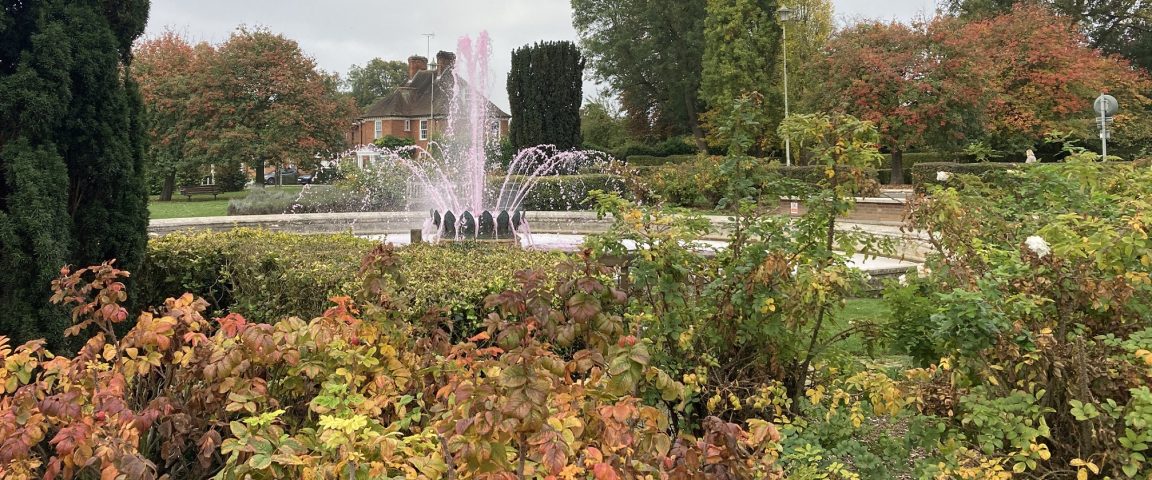
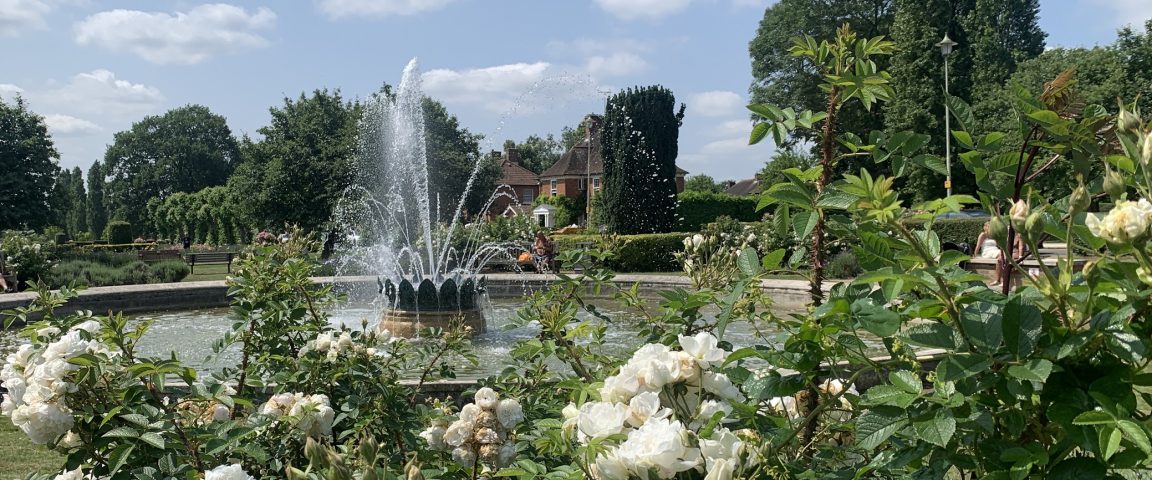
The Coronation Fountain
Fountain
On the 2nd June 1953, Queen Elizabeth II became queen of the United Kingdom and the other Commonwealth realms at Westminster Abbey in London. She reigned for 70 years, the longest serving monarch in the UK.
The fountain was designed by Kenneth Peacock who was a partner of Louis de Soissons Architects. If you look closely, it is a bronze crown set within a stone basin.
During October, the water is dyed pink to recognise Breast Cancer Awareness Month.
Tulip tree
Feature Tree
Non-native originating in North America
An important tree in the Appalachian Mountains for biodiversity, the tulip tree is a little lost in the UK, providing forage for a small number of beetles and the occasional insect.
The large leaves are a curious shape, four shallow, pointed lobes a with rounded base. The very end of the leaf never has a pointed tip, like most leaves but is either squarely flat or even notched inwards. The flowers are like small peachy-yellowy-green, flattish tulips but are seen only with a keen eye.
Turkey oak
Feature Tree
Non-native originating from central and southern Europe
This species is a host of a tiny insect called the knopper gall wasp. The wasp lays its eggs in the acorns of the native pedunculate oak. The little grub which grows eats the inside of the acorn which becomes mutated with frilly knobbles, making the seed unviable. When the insect hatches from the acorn it seeks out a flowering Turkey oak to grow the next generation.
The Turkey oak has acorns but with very ‘bristly’ cups. These often grow away from the leaves on bare twigs as they take more than a year to mature. The leaves have the wavey lobes typical of oak but are pointy. The leaves are longer and narrower than the common English oak.
Whitebeam
Feature Tree
Native
Traditionally a very useful tree with edible berries (once they are very mature) and wood which could be turned into everyday household items from spoons to chair legs.
The whitebeam is hairy. At leaf-out the buds are eye-catchingly white with tiny hairs protecting the delicate tissue from the cold, wind or intense sun. As the leaves unfurl, then mature, the hairs are slowly shed until only the dense hairs on the under leaf remain. Even the new growth on twigs are hairy to start! Spring clusters of flowers are beloved by many species of insect, with red berry bunches loved by birds.
Wild service tree
Feature Tree
Native
This particular tree is unusual tree as it has a prop to help support a large branch. It is also a Girth County Champion of Hertfordshire (on the Tree Register of the British Isles). The tree has a current girth of 295cm! It is very old and has veteran features such as the damage following the top falling off.
There is another wild service tree on The Campus which commemorates the well-known golfer, Nick Faldo, who grew up in WGC. Can you find this tree?
This unassuming tree can often stump a tree spotter! The laves have a very crumped edge, slightly wider towards the bottom. Seeds are hidden in small, hard, brown berry-type fruits with tiny white speckles on. The leaves turn a brown with a hint of purple in autumn.
Park Information
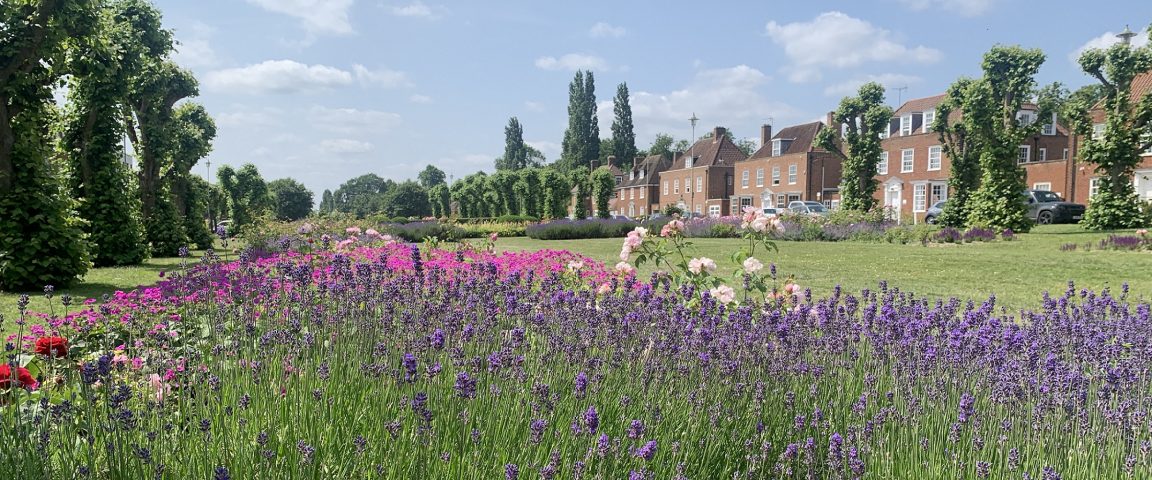
Welwyn Garden City was founded by Sir Ebenezer Howard in 1920, who aimed to combine the benefits of a city and the countryside. The town is laid out along tree-lined boulevards, with wide grass verges and fantastic open spaces for residents and visitors to the town to enjoy.
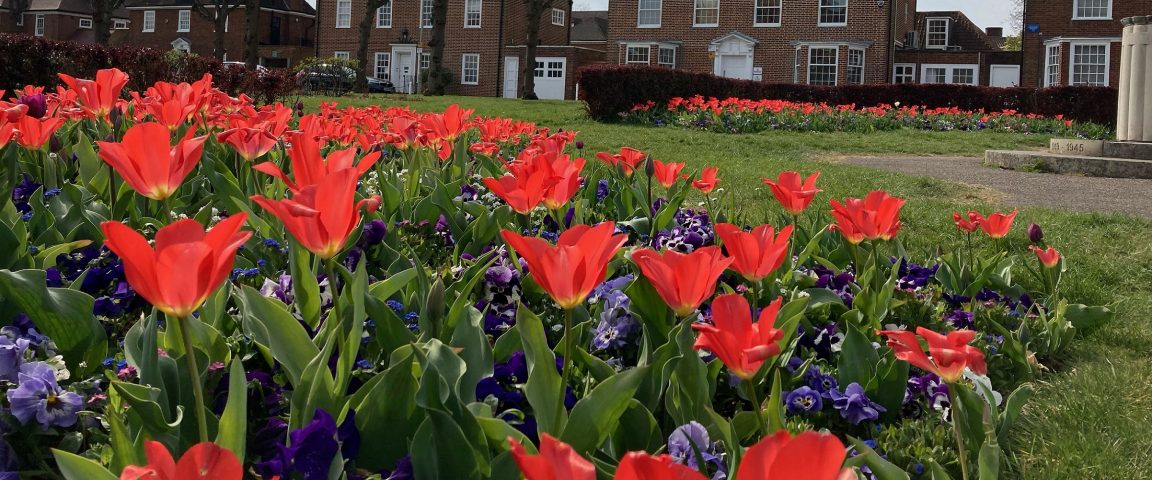
Twice a year we plant different bedding schemes throughout our town centre. Spring bedding is planted out in October, and it starts flowering in the winter right through to the end of the spring, then in June the summer bedding takes over and lasts until the end of the summer months.
The abundant trees create a wonderful backdrop to the planting. Welwyn Hatfield has been awarded ‘Tree City’ status since 1999. The most eye catching being the avenue of limes which run along Parkway and Howardsgate and create a wonderful vista from The Campus viewing point. A tree trail can be found on The Campus which introduces a number of interesting species.
The Centenary Woodland Garden was created with the shade of the wooded area in mind and consists of many varieties of shade-loving plants.
Anniversary Gardens provides an opportunity for peace in the busy town centre. Cherry Tai Haku trees shade the seating area. The surrounding planting scheme, inspired by the founder of the Garden City movement, Ebenezer Howard and the time he spent in Chicago, USA, includes ornamental grasses and prairie plants, such as Echinaceas, Achilleas and Veronicastrums to provide both summer and autumn colour. The design includes the fragrant, apricot rose ‘Rosa Welwyn Garden Glory’ which flowers throughout the summer. This garden was designed with sustainability as well as all year round interest. Drought tolerant species were chosen for their ability to survive our hot, dry spring and summers whilst providing a safe haven of food and shelter to pollinators and other invertebrates.
The long herbaceous borders on Howardsgate are made up completely of sustainable perennial plants. It is very popular with pollinators and the seed heads provide winter beauty and additional food for birds.
All sorts of events and celebrations are hosted each year in the town centre. Attending one of these and then walking around the gardens will provide a full day of pleasure.
Many volunteers help with the planting beds and gardens in the town centre. The various gardens and plantings have been recognised with the following awards;
- Howardsgate and Parkway was awarded Anglia in Bloom Special Award 2023 for Best ‘Public Open Space’ and ‘Local Authority Display’,
- Anniversary Gardens was awarded Anglia in Bloom Special Award 2023 for ‘Best Sustainable Planting’,
- Anglia in Bloom Special Award 2024 for Best ‘Local Authority Floral Display’ & ‘Sustainable Planting’.
Read more on this page about Welwyn Garden City Centre Gardens
On Site Facilities
- Car Park (Pay & Display)

- Disabled Access

- Dogs Welcome

- Pushchair Friendly Paths

How to get here
Parking:Various car parks are available within a short distance. To find the right one for you, search here.
Public Transport Information:Welwyn Garden City has well served bus and train stations within a short distance. Information on public transport is available here: www.intalink.org.uk and www.nationalrail.co.uk.
Cycling:There are various bike parking locations in the town centre.
A bike repair station can be found outside WGC library.

Share your experience
Tell your friends on social media about what you did at Welwyn Garden City Centre Gardens: